By Scott’s Auto Repair | Norco | 951.207.4387
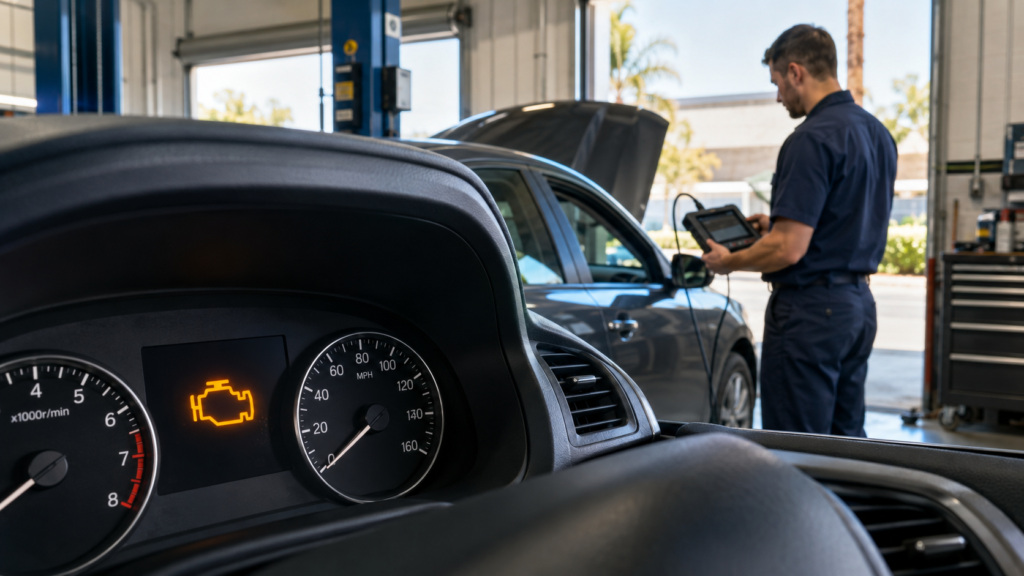
Few dashboard warnings create as much uncertainty as the check engine light. It can appear when your vehicle seems to be running normally, or it may illuminate at the same time the engine begins shaking, losing power, or making an unusual noise. Because the light can indicate anything from a loose gas cap to a serious engine problem, it should never be ignored.
Your vehicle’s onboard computer monitors many systems that affect engine performance, emissions, fuel efficiency, and drivability. When it detects a condition outside the expected range, it may store a diagnostic trouble code and turn on the check engine light.
That code provides an important starting point, but it does not necessarily identify the exact part that needs replacement. Proper check engine light diagnostics involve evaluating the code, inspecting related components, reviewing vehicle data, and determining why the fault occurred.
If your check engine light is on, contact Scott’s Auto Repair in Norco at 951.207.4387 to schedule a professional diagnostic inspection.
💡 What Does the Check Engine Light Look Like?
The check engine warning is usually yellow, orange, or amber. Depending on the vehicle, it may display an engine-shaped symbol or words such as “Check Engine” or “Service Engine Soon.”
Drivers sometimes confuse the check engine light with a maintenance reminder. They serve different purposes.
A maintenance reminder commonly appears when the vehicle reaches a mileage or time interval for routine service, such as an oil change. The check engine light usually means the vehicle’s computer has detected a problem involving a monitored system.
The symbols and messages can vary among makes and models. If you are unsure which warning has appeared, consult your owner’s manual or ask a qualified repair professional.
⚠️ Is the Check Engine Light Steady or Flashing?
One of the first things to notice is whether the light is staying on continuously or flashing.
A Steady Check Engine Light
A solid or steady light generally means the computer has detected a fault that should be diagnosed. The vehicle may still appear to drive normally, but that does not mean the problem is harmless.
A steady light can be associated with an emissions issue, failing sensor, air or fuel problem, ignition fault, leak, or another condition that may become worse over time.
If the vehicle is running normally and no other urgent warning signs are present, reduce unnecessary driving and arrange an appointment with Scott’s Auto Repair as soon as practical.
A Flashing Check Engine Light
A flashing check engine light requires immediate attention. It can indicate a severe misfire or another condition that may quickly damage the catalytic converter or other components.
If the light is flashing:
- Reduce speed and engine load
- Avoid hard acceleration
- Pull over safely as soon as conditions allow
- Turn off the engine
- Arrange for professional assistance or towing
Do not continue driving simply to see whether the light stops flashing. If the engine is shaking, losing power, overheating, smoking, or producing a strong odor, shut the vehicle down in a safe location.
For guidance, call Scott’s Auto Repair in Norco at 951.207.4387.
🔍 Common Reasons the Check Engine Light Turns On
There are many possible causes of an illuminated check engine light. The following are among the problems technicians frequently investigate.
⛽ Loose or Damaged Gas Cap
A loose, missing, or damaged fuel cap can allow fuel vapors to escape from the sealed emissions system. This may cause the computer to detect an evaporative emissions leak and turn on the check engine light.
After refueling, make sure the cap is tightened correctly. Inspect it for cracks, deterioration, or a damaged seal.
A loose cap is one possible cause, but it should not be assumed to be the explanation for every warning light. Even if you tighten the cap, the warning may not disappear immediately. The vehicle may need to complete several self-checks before the computer turns off the light.
If the warning remains on, professional diagnosis is the safest next step.
🔥 Engine Misfire
A misfire occurs when one or more cylinders fail to complete combustion properly. It may be caused by worn spark plugs, faulty ignition components, fuel-delivery problems, air leaks, mechanical issues, or other conditions.
Possible symptoms include:
- Rough idling
- Shaking or vibration
- Hesitation
- Loss of power
- Poor acceleration
- Reduced fuel economy
- A flashing check engine light
Continuing to drive with a serious misfire may damage other components. A flashing light or severe engine vibration should be treated as urgent.
🌬️ Oxygen Sensor Problems
Oxygen sensors monitor the exhaust stream and provide information the vehicle’s computer uses to manage fuel delivery and emissions.
A sensor problem can contribute to poor fuel economy, increased emissions, rough performance, or an illuminated warning light. However, a trouble code involving an oxygen sensor does not always mean the sensor itself is defective. Wiring problems, exhaust leaks, fuel-control issues, or other conditions may produce related codes.
Testing is essential before replacing parts.
♻️ Catalytic Converter Concerns
The catalytic converter helps reduce harmful substances in the vehicle’s exhaust. Converter efficiency can be affected by age, contamination, overheating, repeated misfires, or unresolved engine problems.
Potential symptoms include:
- Reduced engine performance
- Poor acceleration
- Unusual exhaust odors
- Excessive heat underneath the vehicle
- Reduced fuel economy
- A check engine warning
Replacing a catalytic converter without correcting the problem that damaged it may lead to another failure. The engine and fuel-control systems should be evaluated as part of the diagnosis.
📏 Mass Airflow Sensor Issues
The mass airflow sensor measures the amount of air entering the engine. The computer uses this information to calculate fuel delivery.
A contaminated or faulty sensor may cause hesitation, poor fuel economy, hard starting, stalling, or rough performance. Air-filter problems, intake leaks, wiring faults, and other conditions may create similar symptoms.
A technician can review sensor data and related systems to determine the actual cause.
💨 Evaporative Emissions System Leaks
The evaporative emissions system helps contain and manage fuel vapors. A loose gas cap is one possible source of a leak, but hoses, valves, seals, and other components can also fail.
Some leaks are extremely small and may not create any noticeable driving symptoms. Specialized testing may be necessary to locate the source accurately.
🔌 Ignition Coil or Spark Plug Problems
Spark plugs and ignition coils help ignite the air-fuel mixture inside the engine. When one of these components is worn or failing, the engine may misfire, hesitate, shake, or lose power.
Replacing the part named in a trouble code without testing the complete ignition system may not solve the problem. The fault could involve wiring, a connector, fuel delivery, compression, or another related condition.
🧰 What Is a Diagnostic Trouble Code?
When the vehicle’s computer detects a problem, it may store an alphanumeric diagnostic trouble code, often called a DTC. A scan tool can retrieve this code from the onboard diagnostic system.
A common misconception is that the code directly tells the technician which part to replace. In reality, a code identifies the system, circuit, or operating condition in which the computer detected a fault.
For example, a code may indicate a lean condition, misfire, sensor-circuit problem, or emissions leak. Several different failures could produce the same code.
That is why simply reading or clearing the code is not the same as performing a complete diagnosis.
🧑🔧 Why a Code Scan Is Not a Complete Diagnosis
An inexpensive code reader may tell you which trouble code is stored, but it cannot automatically determine the underlying cause.
Professional auto diagnostics in Norco may include:
- Confirming the customer’s concern
- Retrieving stored, pending, and historical codes
- Reviewing freeze-frame information
- Monitoring live sensor data
- Inspecting wiring and electrical connectors
- Testing circuits and components
- Checking for intake or exhaust leaks
- Evaluating ignition and fuel delivery
- Performing mechanical tests when needed
- Verifying the repair afterward
A code related to a sensor could be caused by the sensor, wiring, a poor connection, another failed component, or a mechanical condition that caused the sensor to report an abnormal reading.
Accurate testing helps prevent unnecessary parts replacement and allows the actual problem to be addressed.
🚗 Can You Keep Driving with the Check Engine Light On?
Whether it is safe to continue driving depends on the warning behavior and the vehicle’s symptoms.
Stop driving and seek assistance if:
- The check engine light is flashing
- The engine is shaking severely
- The vehicle is losing significant power
- The temperature gauge shows overheating
- An oil-pressure warning is illuminated
- You see smoke
- You smell fuel or burning material
- The engine is making loud knocking or grinding noises
- The vehicle is stalling or difficult to control
If the light is steady and the vehicle appears to operate normally, you may be able to drive a short distance to a repair facility. However, schedule diagnosis promptly and avoid long trips, towing, heavy acceleration, or unnecessary driving until the cause is known.
If you are uncertain, call Scott’s Auto Repair at 951.207.4387 before continuing to drive.
🗑️ Should You Clear the Check Engine Light Yourself?
Clearing a trouble code does not repair the condition that triggered it. If the fault remains, the light will often return.
Erasing codes can also remove useful diagnostic information, including data captured when the fault occurred. Disconnecting the battery may reset certain vehicle settings and readiness monitors without correcting the problem.
This can make diagnosis more difficult and may interfere with an upcoming emissions inspection. Before clearing the warning, allow a qualified technician to retrieve and document the stored information.
⛽ Can the Check Engine Light Affect Fuel Economy?
Yes. Some faults can cause the engine to use more fuel than necessary. A problem involving air measurement, oxygen-sensor feedback, ignition, fuel control, or engine temperature may reduce efficiency.
You may notice:
- More frequent trips to the gas station
- Rough idling
- Sluggish acceleration
- A fuel smell
- Black exhaust smoke
- Reduced performance
Even when the vehicle seems normal, the computer may be compensating for a fault in a way that increases fuel consumption or emissions. Prompt diagnosis may help prevent wasted fuel and additional damage.
🛡️ How Can You Help Prevent Check Engine Light Problems?
Not every problem is preventable, but regular maintenance can reduce the likelihood of certain failures and help technicians identify developing issues earlier.
Helpful maintenance habits include:
- Following the manufacturer’s service schedule
- Changing engine oil at the appropriate intervals
- Replacing spark plugs as recommended
- Inspecting and replacing air filters
- Maintaining the cooling system
- Using the correct fuel
- Tightening the fuel cap after refueling
- Addressing rough running or poor performance promptly
- Repairing fluid leaks
- Avoiding continued driving when the engine is overheating
- Having warning lights professionally diagnosed
Routine inspections can also reveal deteriorated hoses, damaged wiring, leaks, or worn ignition components before they cause more serious drivability problems.
📍 Check Engine Light Diagnostics in Norco
Drivers in Norco need vehicles they can depend on for commuting, errands, school transportation, work, and daily travel. An illuminated warning light can create uncertainty, especially when the car does not display obvious symptoms.
At Scott’s Auto Repair, the goal of a diagnostic inspection is to identify the reason the warning appeared—not simply replace a part based on a code.
A careful diagnostic process can help determine whether the problem involves ignition, fuel delivery, emissions controls, sensors, electrical circuits, air intake, exhaust, or an internal mechanical condition.
The sooner the issue is evaluated, the better your opportunity to address it before it develops into a breakdown or more expensive repair.
📞 Schedule Check Engine Light Service with Scott’s Auto Repair
Do not cover the warning with tape, repeatedly clear the code, or wait for the vehicle to stop running. Your check engine light is the vehicle’s way of telling you that the onboard computer has detected a problem.
If the light is steady, schedule professional diagnosis as soon as possible. If it is flashing or the vehicle is running poorly, stop driving when safe and arrange assistance.
Contact Scott’s Auto Repair in Norco at 951.207.4387 for dependable check engine light diagnostics, professional auto repair, and friendly local service.
Call 951.207.4387 today to schedule an appointment and get the answers you need before a warning light becomes a larger problem.
Leave a Reply